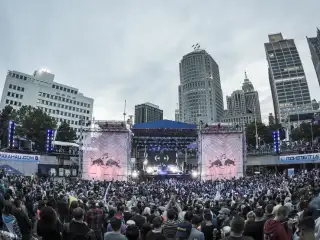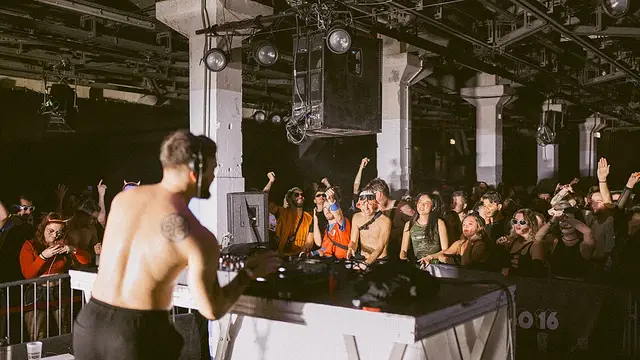
Picture a former factory floor in Warsaw's Praga district on a winter night sometime in the early 2000s. The building has no heating worth mentioning, the permit situation is best described as optimistic, and the sound system is running off a generator that someone's cousin sourced from a construction site. Several hundred people are dancing anyway. Not because the conditions are romantic — they are not — but because this is where the music lives, and the music matters enough to accept the terms. That negotiation, between what the city will sanction and what a community requires in order to exist, is the defining condition of Eastern European club culture. It has been since before the Wall came down.
The Negotiated Floor: Dancing in the Shadow of the State
Eastern European club culture has never existed in a political vacuum. From the final decades of communist rule to the fragmented bureaucratic landscapes that emerged after 1989, the act of gathering to dance has always carried weight beyond the music itself. Unauthorized assembly was not merely inconvenient under Soviet-aligned governance — it was structurally suspect, a category of social behavior that institutions were built to monitor, contain, and disperse. That bureaucratic muscle memory did not dissolve with the political systems that produced it.
Poland's transition to liberal democracy opened new freedoms, but it also created a regulatory vacuum gradually filled by municipal ordinances, noise laws, and zoning codes drafted without cultural spaces in mind. The legislation that arrived to fill the gap was not designed for nightlife; it was designed for order. The result was a patchwork of rules that technically applied to underground events without ever having been written with them in consideration — a situation that gave authorities enormous discretionary power over which gatherings were tolerated and which were not.
The structural tension is not unique to Poland. Comparable dynamics play out across the Czech Republic, Hungary, Romania, and the Baltic states, each carrying their own political textures and institutional histories. What unifies them is a shared inheritance: the state's relationship to public space was calibrated under conditions in which unsanctioned assembly was a political threat, and recalibrating that relationship has proven neither straightforward nor complete. Underground dance culture in this region developed partly in response to institutional exclusion, which means that legitimization and institutionalization have always threatened the very conditions that made the scene coherent in the first place.
The question worth pursuing here is not whether authorities have been hostile — the record is clear enough on that — but what the mechanics of that hostility reveal about how the post-communist state imagines public life and who it considers entitled to participate in it. The factory floor in Praga is not just a venue. It is an argument about belonging.
Warsaw as Flashpoint: The Rave That Made the News
Warsaw has served repeatedly as a stage for confrontations between electronic music culture and state authority, with specific incidents crystallizing broader debates about urban space, youth culture, and the limits of public tolerance. Raves held in the city's post-industrial zones and public parks during the 1990s and into the 2000s forced early confrontations with city authorities, establishing a precedent of disruption and negotiation that the scene carried forward. These moments were not anomalies. They were legible symptoms of a deeper structural friction between a community claiming space and institutions that had not been designed to accommodate that claim.
Polish national media has periodically framed electronic music gatherings as public health crises or moral panics, amplifying official pressure and shaping the political environment in which promoters and organizers must operate. The framing matters as much as the events themselves. When a rave becomes a news story about drugs or disorder rather than about music or community, it shifts the terms of negotiation — local officials who might have exercised discretion find themselves under pressure to demonstrate decisive action, and the scene absorbs the consequences.
Warsaw's rapid urban development and gentrification have steadily erased the marginal, affordable, and semi-legal spaces that once served as natural homes for underground events. The post-industrial geography that made Praga and similar districts hospitable to unofficial culture was temporary by nature — dereliction is a phase, not a permanent condition, and capital eventually arrives. As it did, the club community responded with a range of strategies: cultural licensing applications, partnerships with arts institutions, deliberate engagement with city cultural offices. Each approach carried its own compromises, its own version of the translation problem.
What Warsaw illustrates is a recurring pattern that repeats across the region with local variations: a scene generates enough visibility to attract institutional attention, which forces a choice between formalization and displacement. There is no third option that preserves the original conditions indefinitely. The factory floor eventually gets renovated, or raided, or both.
Up To Date and the Provincial Calculus: Białystok's Experiment in Legitimacy
Up To Date Festival, founded in Białystok in northeastern Poland, represents one of the most sustained attempts by Eastern European electronic music culture to achieve institutional legibility without surrendering its identity. Its history — marked by relocations under pressure, permit denials, and ongoing friction with local authorities — reveals the specific challenges facing scenes that operate outside capital cities and the cultural infrastructure that comes with them. Białystok is not Warsaw. That difference is the whole point.
The city sits in a region of Poland with a distinct political and demographic character — more conservative in its civic culture, more religiously observant, and historically more skeptical of countercultural expression than the capital or Kraków. For a festival committed to international electronic music programming, Białystok is genuinely difficult terrain. Up To Date's repeated relocations in response to complaints, permit denials, and environmental regulations illustrate how a festival's geography is never neutral. Each venue choice is a political act as much as a logistical one. Where you hold the event communicates something about who you think you are and who you think the city is.
The festival's international booking policy — drawing artists from Berlin, London, and global underground circuits — has simultaneously bolstered its cultural credibility and made it a target for nationalist and traditionalist critics who read cosmopolitan programming as cultural provocation. Environmental regulations, including noise ordinances tied to EU-harmonized standards and restrictions on events near protected natural areas, have added a further layer of constraint that sits awkwardly alongside genuine ecological concerns. The regulations are not always acting in bad faith; the difficulty is that they apply with equal force regardless of intent.
Up To Date's persistence across more than a decade of institutional friction makes it a case study not in resilience as triumph but in the ongoing cost of survival. The organizational energy consumed by permit applications, venue negotiations, and public relations battles is energy not spent on artistic risk-taking, community development, or long-term programming ambition. The festival exists, which is significant. But what it might have become in a more hospitable environment is a question the region's political conditions have made unanswerable.
The Region in Full: Prague, Budapest, Bucharest, and the Architecture of Resistance
Poland's struggles are part of a broader Eastern European story in which club culture has developed distinct survival strategies depending on local political conditions, urban geography, and the specific character of state and municipal power. Prague's scene navigated a different but comparable arc: post-Velvet Revolution liberalism initially created space for independent culture, but increasing commercialization and tourist-driven development gradually pushed independent venues out of the city center, replacing the conditions that had nurtured underground culture with a hospitality economy oriented toward a different kind of visitor entirely.
Budapest under Viktor Orbán's government has seen cultural funding weaponized against spaces associated with liberal or LGBTQ+ communities, creating a climate of self-censorship and strategic invisibility among promoters. The pressure is not always direct — it operates through subsidy decisions, zoning reviews, and the chilling effect of knowing which associations will attract unwanted attention. The result is a scene that has learned to be careful about its own visibility, which is a particular kind of damage to a culture that once defined itself by the audacity of simply showing up.
Bucharest's club scene, centered on venues like Control and rooted in the globally significant tradition of Romanian minimal techno, built its identity partly by operating in a legal gray zone that became increasingly difficult to maintain as the city modernized and municipal attention sharpened. The sound that emerged from Bucharest's underground — spare, hypnotic, deeply functional — carries the aesthetic logic of spaces that couldn't afford to be conspicuous. It is not incidental that music shaped under institutional pressure should sound the way it does.
The Baltic states — particularly Tallinn and Vilnius — have developed club cultures that draw on a specific post-Soviet pride in reclaiming public space, a different but equally fraught relationship to municipal authority. Across the region, the most durable scenes share a common characteristic: they built genuine community infrastructure — record shops, collective studios, DIY print culture — rather than relying solely on event programming. Those roots survive venue closures and permit denials in ways that a calendar of events cannot.
Going Above Ground: What Gets Lost in Translation
When underground culture seeks institutional recognition — through festival licensing, arts council funding, or municipal partnership — it inevitably enters a translation process that reshapes it in ways not always visible from the outside. Arts funding frameworks in post-communist Poland and neighboring states were built around national cultural identity narratives: folk tradition, classical music, literary heritage. These categories have no natural place for techno or rave culture, which means that anyone seeking institutional support must first argue that their work belongs in a conversation it was never invited to join.
Promoters and organizers who pursue institutional legitimacy often find themselves writing grant applications that reframe dance culture as "community cohesion" or "urban regeneration." The language is not inaccurate — electronic music scenes do build community, and they do reshape urban environments — but it is reductive, and it shapes how the culture understands itself over time. When you spend years explaining what you do in someone else's vocabulary, you begin to hear yourself differently.
The professionalization required by legal compliance — insurance, security contracts, sound monitoring, ticketing infrastructure — shifts the economics of events in ways that gradually exclude the low-income participants who were often central to the scene's original character. This is not a side effect; it is the mechanism. Formalization raises the floor, and raising the floor changes who is standing on it. Some Eastern European collectives have consciously chosen to remain small, informal, and deliberately undocumented rather than pursue growth that would require institutional engagement — a choice that preserves integrity but limits reach and the transmission of knowledge to younger generations.
The translation problem is ultimately a question of power: whose definition of cultural value gets to determine which spaces survive, which communities are served, and which forms of collective experience the city considers worth protecting. The answer in most Eastern European municipalities has been consistent, if not always explicit. The city protects what it already recognizes.
The Cost of Keeping Moving: Survival, Displacement, and What the Scene Carries Forward
Eastern Europe's electronic music culture has demonstrated extraordinary adaptive capacity under institutional pressure, but adaptation is not the same as thriving. The constant need to relocate, reapply, and rebrand consumes creative and organizational energy that might otherwise go into artistic risk-taking, community development, or the mentorship of younger participants. Scenes that survive this way are not weakened — they are often remarkably resilient — but they are shaped by the survival itself, and that shaping leaves marks.
Displacement is not evenly distributed. The promoters, artists, and communities with the least financial and social capital bear the heaviest costs when venues close and events are shut down, while the most established figures absorb the losses more easily. The underground mythology of collective solidarity is real — the scenes described here were built on genuine mutual support — but it has never been sufficient to fully equalize what institutional hostility costs at the individual level. The person who loses the most when a venue closes is rarely the person whose name is on the poster.
The scenes that have survived longest in Eastern Europe share a common characteristic: they maintained enough ambiguity — legal, spatial, aesthetic — to avoid becoming legible targets for any single institutional actor. International attention, including coverage in global music media, has created a double-edged dynamic in this regard. It raises the profile of scenes and attracts resources, solidarity, and visiting artists. It also increases visibility in ways that can accelerate the political pressures that threaten them. Being written about is not neutral.
What Eastern Europe's club culture carries forward is not optimism — the history is too complicated for that — but a practiced knowledge of how to build meaning in hostile conditions. That knowledge has been transmitted across generations not through institutions but through the informal networks of people who showed up, kept the music going, and passed the lesson on. In the absence of institutional memory, the community became the archive. In the absence of protected spaces, the gathering itself became the argument. That is not a solution to the structural tensions this piece has traced. But it is, in its way, an answer.

Compartilhar
Entre para participar da conversa. Entrar
Ainda não há comentários. Seja o primeiro a opinar.