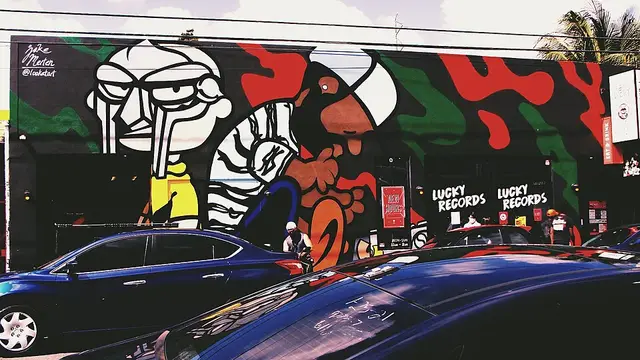
Picture two rooms, thousands of miles apart, sometime in the late 1990s. In Detroit's Conant Gardens neighborhood, James Dewitt Yancey — J Dilla — sits with a sampler and a crate of records, pulling fragments of sound from the past and reassembling them into something that feels like a dream you can't quite name. In Shibuya, Tokyo, Jun Seba — Nujabes — does the same, surrounded by the inventory of his independent record shop, building beats with the quiet focus of a man conducting a private ceremony. Neither knows the other is working. Neither needs to.
The Distance Between Detroit and Tokyo Was Never as Wide as It Seemed
Nujabes operated from Shibuya with a degree of independence that defined his entire practice. His shop, Guinness Records, was less a retail space than a curatorial statement, and the label he built — Hydeout Productions — became the institutional center of Japan's underground hip-hop scene through the 1990s and early 2000s. He was embedded in a community but moved through it on his own terms, answering to no commercial logic other than his own.
Dilla came up shaped by Detroit's musical density — Motown's harmonic legacy, the gospel tradition his mother Maureen 'Ma Dukes' Yancey carried in her voice, the funk and soul saturating the city's cultural atmosphere. He later became a gravitational force within the Soulquarians collective, working alongside Questlove, Common, and Erykah Badu, but the core of his practice remained something he had developed alone, in his bedroom, on equipment most producers considered secondary.
Both men worked at an angle to the commercial mainstream — influential enough to shape what surrounded them, never captured by it. Both died young: Dilla from complications of lupus and TTP in February 2006, at 32; Nujabes in a traffic accident in 2010, at 36. The catalogues they left behind have not faded. They have deepened, the way certain texts deepen with rereading.
To frame their parallel development as coincidence is to miss the structural argument. When two artists working in genuine isolation arrive at nearly identical emotional architectures, something beyond accident is at work. Their convergence points to a truth about what music becomes when an artist listens deeply enough, and honestly enough, to what the materials are asking for.
Jazz as a Second Language: How Both Producers Learned to Speak Through Samples
Dilla's relationship to jazz was physical and inherited. Detroit's proximity to post-bop and hard bop meant jazz records were household objects in the Yancey home, not museum pieces. His mother's gospel grounded him in Black American musical memory from childhood, making jazz less a genre to be studied than a language already partially known — available for transformation rather than quotation.
Nujabes arrived at jazz through a different door. Japan's jazz kissa culture — the intimate listening cafés that flourished from the 1950s onward, where records were played on high-end equipment for audiences who treated listening as a discipline — gave him access to the form through an atmosphere of reverence. His relationship to jazz was devotional and intellectually serious, shaped by a tradition that understood the music as something to be honored rather than consumed.
What both producers did with jazz was structurally similar in ways that defy their different entry points. Each favored minor keys, modal chord progressions, and melodic loops that refused resolution — loops that invited the listener into a sustained emotional state rather than delivering a payoff. The technique owes more to Miles Davis's *Kind of Blue* than to conventional hip-hop loop architecture, building tension not through contrast but through the patient accumulation of unresolved feeling.
On Slum Village's *Fantastic Vol. 2* and his own solo masterwork *Donuts*, Dilla chopped jazz phrases into micro-rhythmic fragments that preserved the emotional warmth of the original while dismantling its internal logic entirely. Nujabes, on *Metaphorical Music* and the *Samurai Champloo* soundtrack, layered his samples with a patience that felt almost meditative — allowing phrases to breathe and decay in ways that recalled the Japanese aesthetic concept of *ma*, the productive significance of negative space, as much as any Western production convention.
Broken Time: The Revolutionary Rhythmic Grammar They Shared
Among producers, Dilla's rejection of the quantize function became the stuff of ongoing conversation. Quantization is the digital tool that locks drum hits to a mathematically perfect grid, producing the mechanical precision that characterized mainstream hip-hop production through much of the 1990s. Dilla abandoned it, letting his drums fall behind and ahead of the beat in ways that mimicked the irreducible human quality of live performance. Producers and musicians began calling it "the Dilla feel," or "drunk swing" — terms that tried to describe something resisting technical description.
Nujabes achieved comparable looseness through different means. Rather than drum programming, he worked through layering and arrangement — building rhythmic foundations that felt perpetually suspended, as if the melodic and harmonic material floating above them was gently dissolving the beat's structural authority. The effect was rhythmic, but it didn't feel mechanical. It felt like thinking.
Both approaches drew from the same older tradition: the intentional imprecision of blues and soul recordings, where timing was an expressive instrument rather than a technical liability. The blues piano landing slightly behind the downbeat wasn't failing to meet the grid — it was refusing the grid in favor of something that communicated more directly. Dilla and Nujabes understood this instinctively, arriving from opposite directions.
The shared effect was music that felt like it was being remembered rather than performed — arriving slightly displaced from its own beat in ways that evoked the unreliability of recollection. The generation of producers who followed them, from Flying Lotus to Knxwledge to the lo-fi beatmakers who came after, inherited this rhythmic philosophy as something close to an ethical position: a refusal to sand the human fingerprint from the music.
Grief as a Compositional Method: Making Music That Feels Like Loss
*Donuts* — widely understood as Dilla's defining statement — was composed while he was hospitalized in significant physical decline, working from a portable sampler at his bedside. Released three days before his death in February 2006, the album is not simply a document of illness. It is a formal argument, made under conditions of profound constraint, about what music can hold. Many listeners hear it as a deliberate farewell, though Dilla left no manifesto. The music makes the case itself.
Nujabes rarely spoke about mortality in interviews. But his music — particularly on *Modal Soul* — carries an elegiac quality that collaborators and listeners have consistently described as pointing toward something beyond ordinary sadness. That quality became more legible after his death in 2010, but it was always present in the work, audible to anyone who sat with it long enough.
Japanese aesthetic philosophy offers a frame here that Western critical language struggles to provide. *Mono no aware* — a bittersweet sensitivity to the transience of things, a tenderness toward impermanence — runs through Nujabes's production in ways that suggest something more than personal temperament. It is a culturally conditioned orientation toward beauty-as-loss, distinct from but structurally parallel to the blues-rooted emotional vocabulary that shaped Dilla's sensibility from childhood.
What both producers made was music that seemed to mourn something unnamed — not a specific grief but a condition of being, a sustained awareness of the fragility of the present moment. This is why their work has served so many listeners as a companion through personal loss. The music was already inside that emotional register before any individual grief arrived to meet it. The posthumous expansion of both their audiences is its own evidence: music made in proximity to death tends to outlast music made for immediate consumption.
Two Scenes, One Inheritance: How Their Influence Traveled Across Borders
Dilla's production credits trace an arc through some of the most significant hip-hop and neo-soul recordings of the 1990s and 2000s — A Tribe Called Quest's *Beats, Rhymes and Life*, Erykah Badu's *Mama's Gun*, Common's *Like Water for Chocolate*. His techniques became audible across an entire generation of music, absorbed so thoroughly that many listeners encountered his influence without ever knowing its source. That is the mark of a producer who reshaped the grammar of a form.
Nujabes reached international audiences primarily through the *Samurai Champloo* soundtrack, for the 2004 series directed by Shinichiro Watanabe that fused Edo-period Japan with hip-hop aesthetics. The series introduced his production to a global audience that crossed substantially with anime fandom — a community already practiced in consuming Japanese cultural forms on their own terms, without requiring translation into Western frameworks. It was an unlikely but structurally perfect vehicle for his work.
Japan's underground hip-hop scene, which Nujabes helped shape through Hydeout Productions and his Shibuya shop, had always operated in productive dialogue with American hip-hop without being subordinate to it — a relationship of transformation rather than imitation, absorbing the form, running it through different cultural and aesthetic conditions, returning something distinct. This is precisely the dynamic that made Nujabes possible.
The lo-fi hip-hop movement that coalesced through YouTube livestreams and streaming playlists drew explicitly on both traditions, with Nujabes and Dilla named repeatedly as twin patron saints of its melancholic, jazz-inflected sound. That their influences converged in a genre neither man intended to create is perhaps the clearest evidence for the central argument here: the aesthetic each independently developed was stable and universal enough to serve as the foundation for something entirely new.
What the Convergence Means: Universality, Roots, and the Music That Outlasts Its Makers
The parallel development of Nujabes and Dilla challenges a persistent assumption about how musical innovation moves through the world — that it travels from a cultural center outward, that influence flows in one direction. What their story demonstrates instead is that profound formal discoveries can happen simultaneously in places that have absorbed the same raw materials and asked the same deep questions of them. Detroit and Tokyo were not exchanging ideas. They were independently solving the same problem.
Both men were archivists as well as creators — record collectors, crate diggers, students of musical history who spent years in the physical presence of recorded sound before they began making their own. That depth of listening is inseparable from the depth of their output. What they created came from immersion, not invention from nothing. The innovation was in what they heard inside the archive that others had missed.
Their catalogues have become something close to sacred texts for the communities that carry them, but this is not simply a projection of loss onto music that happened to be made by men who died young. The music itself invited that relationship — through its internal qualities of impermanence and tenderness, through its refusal to resolve, through its willingness to sit inside grief rather than move past it. The devotion their listeners feel is a response to something the music actually does.
To listen to Nujabes or Dilla is to be reminded of what music is ultimately for: not for markets or moments, but for the parts of human experience — grief, longing, beauty, the passage of time — that resist being packaged and persist long after the commercial context of their making has dissolved. And to listen to both, knowing their story, is to understand that the most local music — rooted in a specific city, a specific scene, a specific set of cultural conditions — is often the most universal. Because it is made with enough specificity and honesty to reach something beneath cultural difference entirely, into the frequency that both men, from opposite ends of the world, somehow knew to tune toward.

Delen
Log in om mee te praten. Inloggen
Nog geen reacties. Wees de eerste om iets te delen.